


Page 89 - CSS
P. 89
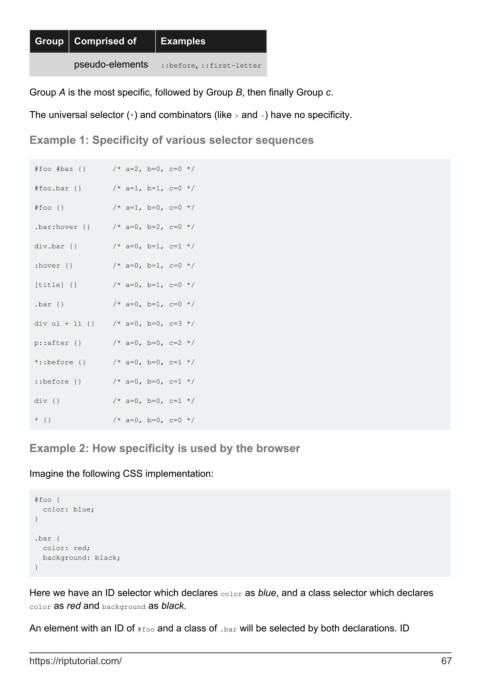
Group    Comprised of          Examples

                   pseudo-elements       ::before, ::first-letter


        Group A is the most specific, followed by Group B, then finally Group c.

        The universal selector (*) and combinators (like > and ~) have no specificity.


        Example 1: Specificity of various selector sequences


         #foo #baz {}      /* a=2, b=0, c=0 */

         #foo.bar {}       /* a=1, b=1, c=0 */

         #foo {}           /* a=1, b=0, c=0 */

         .bar:hover {}     /* a=0, b=2, c=0 */

         div.bar {}        /* a=0, b=1, c=1 */

         :hover {}         /* a=0, b=1, c=0 */

         [title] {}        /* a=0, b=1, c=0 */

         .bar {}           /* a=0, b=1, c=0 */

         div ul + li {}    /* a=0, b=0, c=3 */

         p::after {}       /* a=0, b=0, c=2 */

         *::before {}      /* a=0, b=0, c=1 */

         ::before {}       /* a=0, b=0, c=1 */

         div {}            /* a=0, b=0, c=1 */

         * {}              /* a=0, b=0, c=0 */


        Example 2: How specificity is used by the browser


        Imagine the following CSS implementation:


         #foo {
           color: blue;
         }

         .bar {
           color: red;
           background: black;
         }


        Here we have an ID selector which declares color as blue, and a class selector which declares
        color as red and background as black.


        An element with an ID of #foo and a class of .bar will be selected by both declarations. ID


        https://riptutorial.com/                                                                               67

